
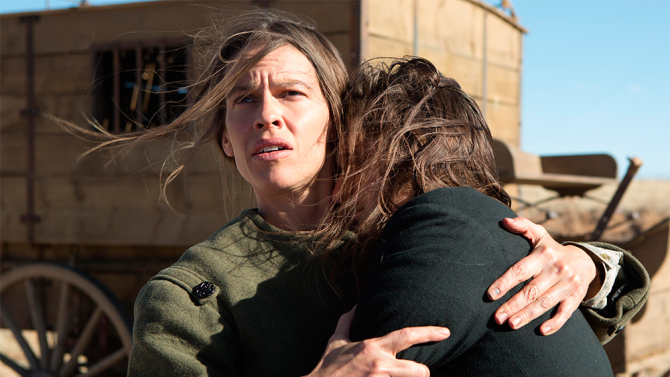
Hilary Swank in The Homesman
The Homesman (Tommy Lee Jones)
In Tommy Lee Jones’s second directorial effort he gives us the story of a pioneer woman (Hilary Swank) who is an independently wealthy spinster whom the townspeople respect but that no one wants to marry (she’s told twice that she’s “bossy”). She embarks on a mission to take three women suffering from intense mental illnesses across the Missouri River from Nebraska to Iowa to be cared for (and to release the burden from their families) when she encounters Jones’s “Mr. Briggs” hanging from a noose atop his horse. A deal is struck to help her get the women to safety.
All of the right things seem to be in place but Jones doesn’t quite successfully merge the extreme tone shifts that often occur in the same scene. It’s as if he doesn’t trust the scenes themselves; the impact of a dramatic moment is constantly being cut short by a joke or a crack, usually by Jones’s rascally outlaw himself. It feels like a missed opportunity but there is still quite a bit to enjoy. The gorgeous frontier landscape is captured thanks to the stunning yet subtle work by cinematographer Rodriego Prieto and the beautiful, traditional score composed by Marco Beltrami, which make for a visually and aurally detailed experience.

Marion Cotillard in Two Days, One Night
Two Days, One Night (Jean-Pierre and Luc Dardenne)
The Dardenne Brothers make amazing films that detail individual human experience extraordinarily well and Two Days, One Night is no exception. Working with their highest profile actor to date (Marion Cotillard), they elicit quite possibly the most expressive and deceptively simple performances in their canon.
Upon learning that a vote by co-workers to lay her off (in favor of a work bonus for them) has been cast against her at the solar plant where she works, Cotillard’s Sandra embarks on a desperate weekend mission to change their minds and keep her job instead of their bonuses. It’s the type of blue-collar humanism the Dardennes are famous for and here, because of the time constraint, we are plunged into this urgent situation that yo-yos back and forth between hopeful and despondent and provides us with a stunning central drama and performance by Cotillard, in her best work since her Oscar-winning turn in La vie en Rose.